Natural selection drift is the violation of the 4th assumption of HWE in Mendelian inheritance: alleles can’t change from individual to gene pool.
It is the process that generates novelty, all evolutionary change requires this mechanism.
A mutation is the spontaneous change of an allele from a parent to its offspring.
Population genetics approach
Mutations as an evolutionary force
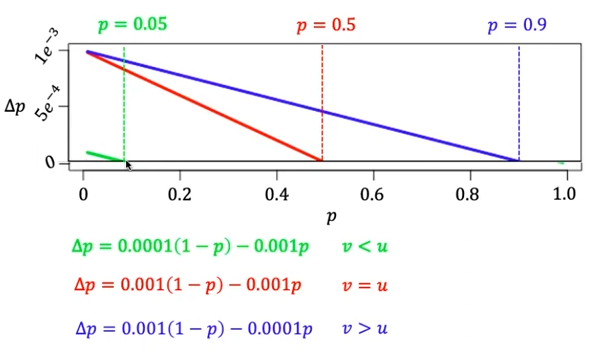
In the simplest case, forward mutations occur from to only. For and :
Genotypes:
Alleles:
For even high mutation rates (), recurrent mutation is very slow. For a realistic mutation rate (), it would take ~69M generations for to fo from 0.5 to 0.25.
Because of that, many geneticists thought that mutation pressure alone was not an important evolutionary force.
With both forward and backward mutation and :
The stable equilibrium is:
Role in evolutionary theory
Mendelians viewed mutation as central. Darwinists viewed it as supplying the “raw material” of evolution: selection picks and chosses from these materials.
Early theoretical population genetics treated populations as having effectively infinite Variation.
The common view is that mutation is random while selection is purposeful. This why highlighted by the Lederberg experiment.
Biology
DNA replication
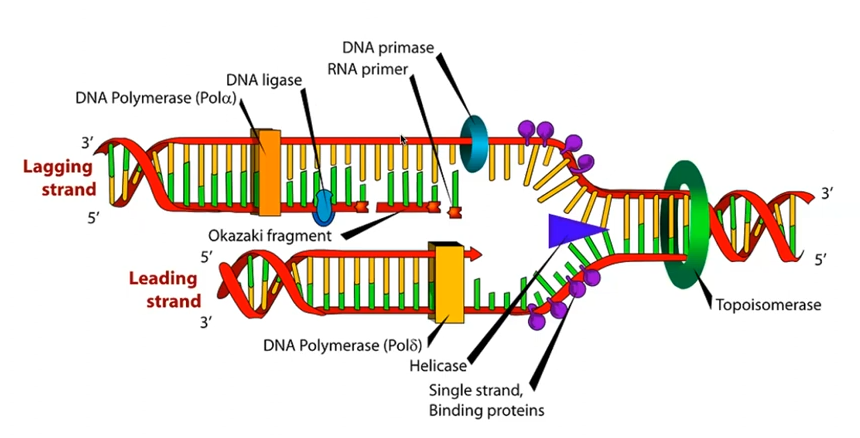
Most mutation happens during replication. During replication, the DNA helix is unwinded and each strand is duplicated. One is replicated continuously (the leading strand) and the other discontinuously.
DNA polymerases have an error-correcting mechanism. If they put the wrong nucleotide, they can stop and take a single step back to correct it.
Mutation mechanisms
Mutation =/= DNA damage! Mutations are the consequence of inexact repair of damage or inexact replication.
- DNA polymerase III and I inexact copying and failure to identify mismatch. It can be substitution, deletion or addition. Rates are ~ in humans.
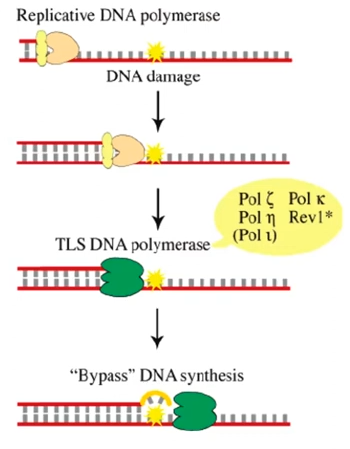
- Error prone trans-lesion synthesis: when polymerase III falls off on a damaged site and is replaced with IV or V, which can bypass the site but is error-prone.
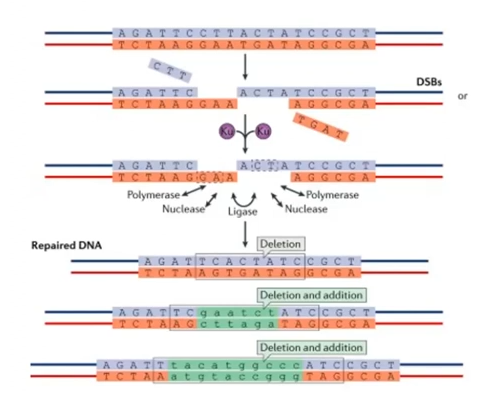
- Non-homologous end-joining: the method for fixing DNA double-stranded break uses overhangs as templates. If breaks are uneven, it can lead to deletions. This mechanism is responsible for many kinds of translocations and end-to-end fusion of chromosomes.
- Oxidative stress: reactive oxygen is generated by the electron transport chain and can oxidize nucleotides.
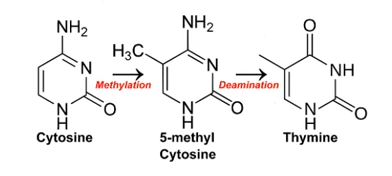
- Deamination at CpG (cytosine, phosphate, guanine) sites. CpG sites are already rare due to their high mutation rate.
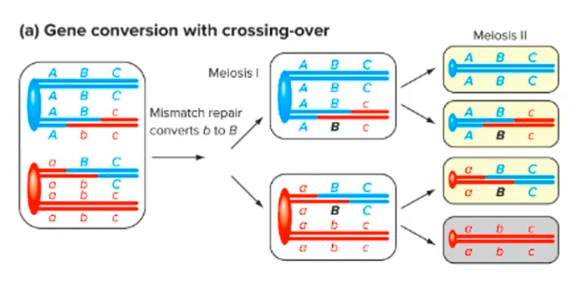
- Bias gene conversion: during recombination, a strand preferentially acts as the template for the other. It happens mostly on GC-rich regions.
- Insertional mutagenesis: insertion of endogenous (transposons, mRNA transcripts, mitochondrial transcripts) or exogenous (retroviruses) DNA into a new location.
- Gene duplication: small duplications caused by polymerase slippage, or large duplications caused by unequal crossing-over during recombination.
Randomness
Whether mutations are random or not depends on what we mean by randomness:
- Randomness as lacking pattern or predictability: no because we can locate recombination hotspots and predict mutation types at CpG sites.
- Randomness as individually unpredictable but following a probabilistic distribution holds up.
- Randomness with respect to genomic location: clearly false, for the same reasons as before.
- Randomness with respect to the environment: no because organisms living in areas with high UV incidence have higher mutation rates.
- Randomness with respect to fitness: no because mutations have an impact on fitness.
- Randomness with respect to their fitness effects: yes, because mutations occur independently of whether they are needed.
Some mutations are more likely to occur than others, but independently of their fitness effects.
Origin of new genes via mutation
There are multiple ways mutations can lead to novelty.
De novo gene synthesis
De novo gene synthesis is the emergence of a new gene from intergenic sequences (regions between genes without prior use in genes).
This occurs via the acquisition of an open reading frame (stretch of DNA between a start codon and a stop codon).
Durand et al. (2019)1 observed that in a wild yeast species. They found new polymorphic genes, most were short and had low translational efficiency. But some of them were de novo and had acquired on open reading frame increasing their translational efficiency.
Neofunctionalization
Neofunctionalization can occur following gene duplication, in which a copy acquires a novel function.
For example, maize underwent a recent whole genome duplication event. ~13% of all duplicates acquired novel regulatory functions.
Insertional co-option
Retrogenes are processed mRNAs that become reverse-transcribed and inserted back into the genome.
Most are expressed at very low levels, but some are highly expressed.
They have co-opted promoters from other regions, CpG sites, or acquired them de novo.
88-280 retrogenes have been found to be co-opted in each species evaluated.2
From Zach B. Hancock, Mutation | The Causes of Evolution | Ep. 4