Gene flow is the violation of the 6th assumption of HWE in Mendelian inheritance: alleles aren’t added to the gene pool from other populations.
It is the movement of alleles between populations or species.
Models of gene flow may be spatial or non-spatial.
Population structure (Non-random mating) is an emergent property of limited gene flow.
Population models
Hierarchy of terms:
-
Species
-
Population
-
Subpopulation/deme/patch
-
Migration: movement of genes between discrete demes
-
Dispersal: indivual-based movements on a continuous landscape
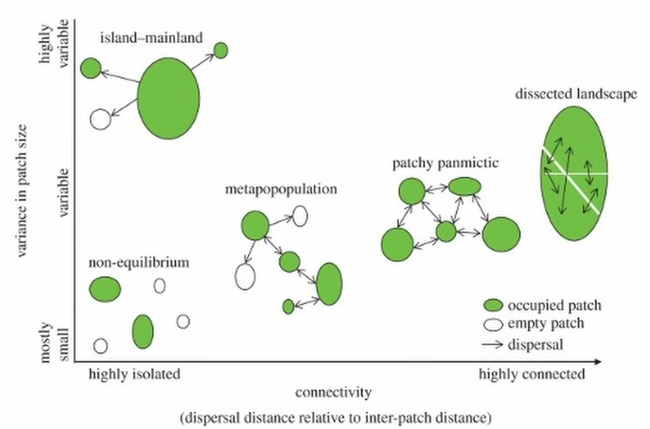
Migration is typically measured in rates rather than absolute numbers.
Continent-island
Represents unidirectional flow.
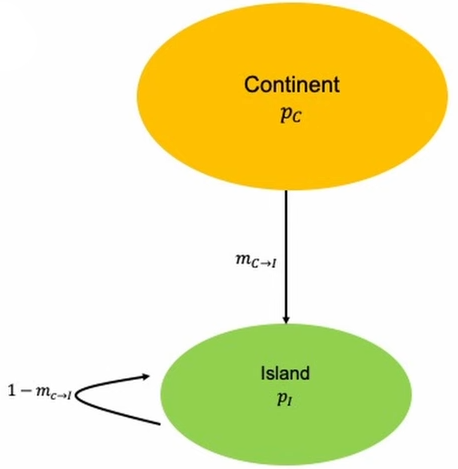
Change in allele frequency is the change in the resident vs migrant frequency of the island population:
For example:
- If , increases
- If , decreases
Equilibrium is when . Gene flow homogenizes allele frequencies.
The rate wat which equilibrium is approached is a function of .
Wright’s island
Represents demes with rates of migration between each other.
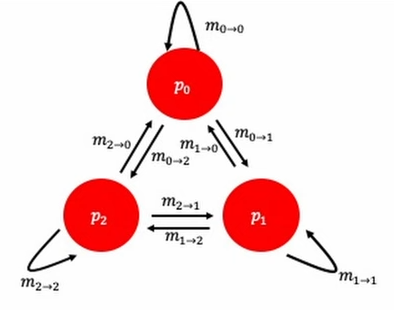
Since migrants come from any subpopulation, their allele frequencies converge towards the global average allele frequency .
It is of the same form as the equation for forward and backward Mutation:
Hence, migration behaves like mutation, it maintains diversity in populations.
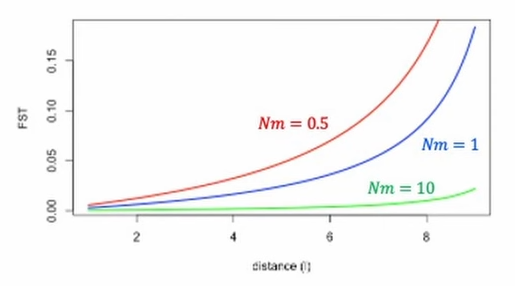
Isolation-by-distance
Represents multiple subpopulations only connected to their immediat neighbors.
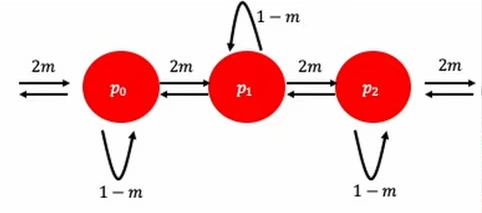
Such models generate correlations between neighbors.1 between two lineages separated by demes () is:
Spatial population genetics
More refined models:
- Seek to preserve spatial context of evolution
- Dispenses with populations and considers a continuum of allele frequencies
- Treats dispersal as a property of individuals (no migration rate or admixture)
Principles
- Individuals on a continuous plane
- Mate choise occurs within a limited radius around the focal individual
- Dispersal is a property of offspring who move away from the midpoint of parents
- Movement can be hindered by landscape features
- Patterns of isolation-by-distance differ depending on the dimensionality of the range
- Local population density dictates rates of coalescence
This model can explain how inbreeding can occur even in large populations in low-density areas.
Dispersal
Dispersal is modeled as a Diffusion process.
It occurs from a parental midpoint, its distance follows a normal distribution of mean and standard deviation .
In 1D, brownian motion lineages eventually coalesce. In 2D, the probability of that happeneing is 0.2
Wright’s neighborhood size
As becomes small, we can assume:
Where is Wright’s neighborhood size.
It is the number of potential mates around a focal individual.
It dictates the rate of genetic drift locally and determines the slope of isolation-by-distance.
Range geometry
Multiple models can be used to avoid edges:
- Infinite plane
- Infinite linear
- Linear joined at the ends
- Toroidal
Effect of edges
In 1D, the probability of coalescence depends on the distance between sample lineages, and where those lineages were samples in space.3
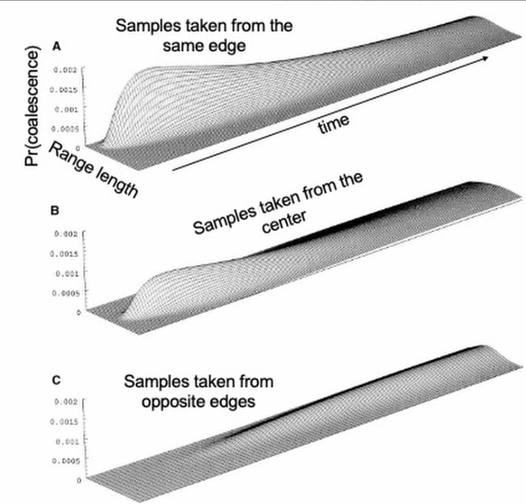
On the same edge, coalescence probability is higher sooner in time. On opposite edges, coalescence probability is low and takes time to increase.
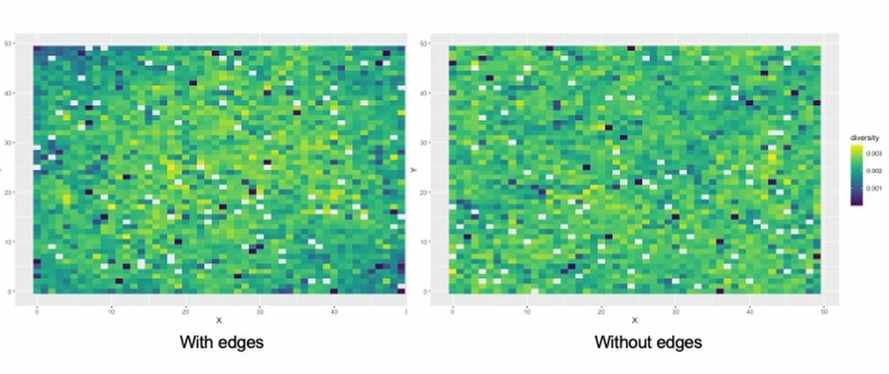
In 2D, genetic diversity is higher in the center than near the edges.
Isolation-by-distance
Assuming an infinite plane and homogenous population density:
Where is the characteristic length and is the Bessel function.
goes to as goes to infinity.
Gene flow between species
Gene flow can also occur between species, through hybridization or horizontal transfer.
Those processses produce result that are equivalent to mutation.
Hybridization often leads to:
- Reduced fitness
- Hybrid vigor (better fitness)
- Gene swamping/hybrid swarm
From Zach B. Hancock, Gene Flow | The Causes of Evolution | Ep. 6