Twin studies are methods used to estimate Heritability. The idea is to use twins who share known proportion of their genome to estimate the impact of genes on traits.
They rely on the ACE model, which separates phenotypic variance into:
- Additive genetic variance
- Shared environment
- Non-shared environment
There are two main types of twin studies.
MZ-DZ
We measure the correlations of a trait among monozygotic twins, who share 100% of their genes, and dizygotic twins, who share 50% of their genes.
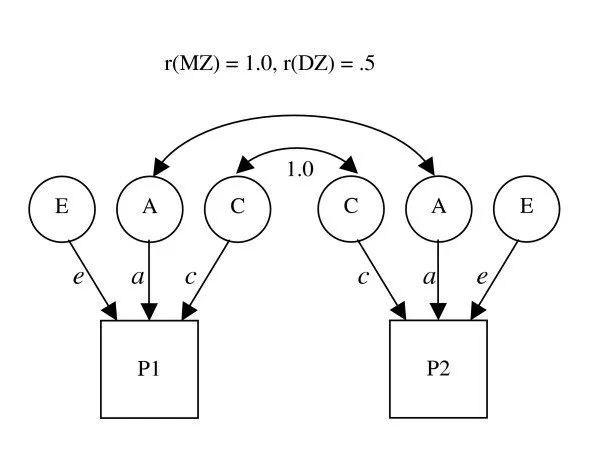
Assumptions:
- EEA (equal environments assumption): MZ and DZ twins live under equally similar environments
- Random mating
- No gene-environment interaction or correlation
Narrow-sense heritability is then .
Violation of EEA leads to overestimating heritability, as parents treat monozygotic twins more similarly, making them have higher correlation in observed traits. Positive assortative mating leads to underestimate heritability, as correlation between mother and father genomes makes dizygotic twins more similar.
MZA
We measure the correlation between monozygotic twins raised in different families, and compare them to correlation between unrelated individuals which is expected to be 0.
Additional assumptions:
- No selective adoptee placement
- Independent rearing environments
Broad-sense heritability is then .